
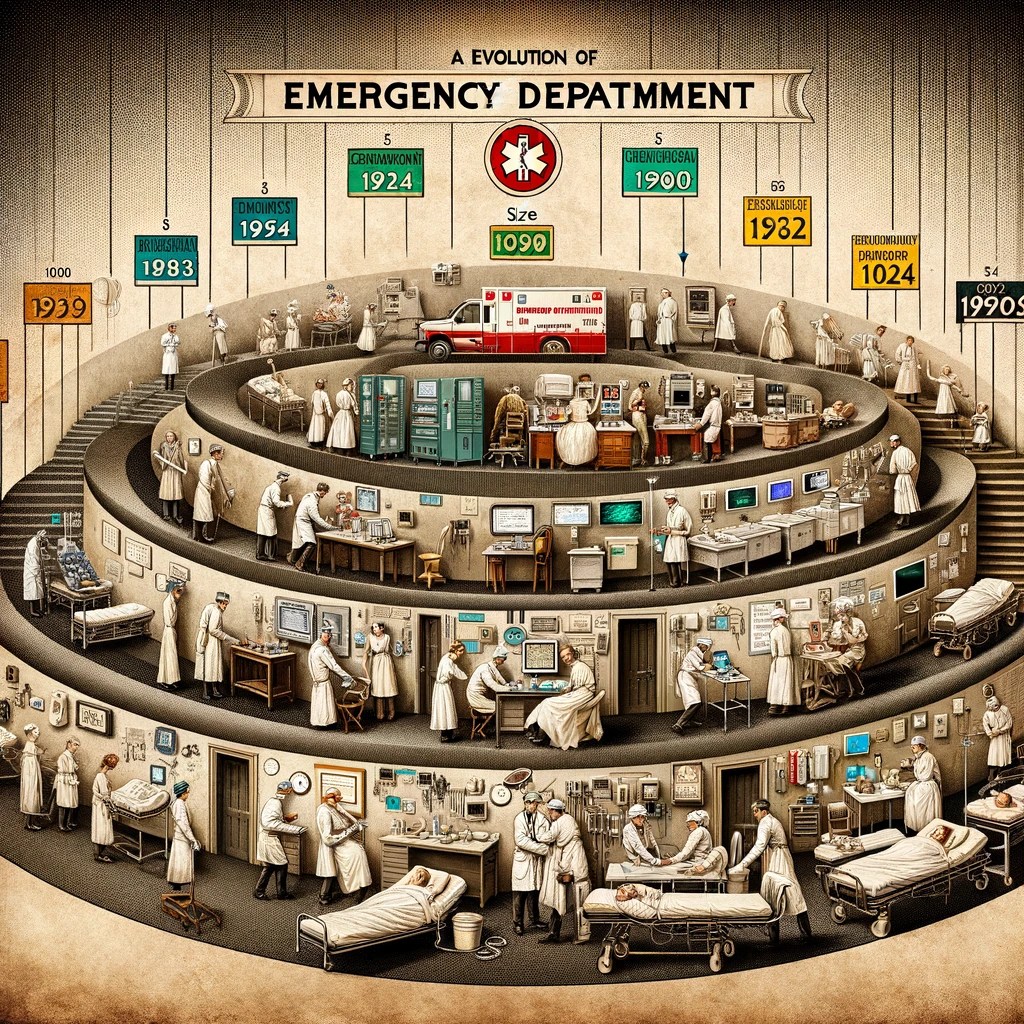
To tell the truth, the emergency department (ED) of current times is the front-line of direct health care in each and every modern hospital. The very concept and structure of the EDs we see today did not crop up overnight.
These offer one of the most intriguing paths to innovation, societal need, and the advance of medicine: the growth of hospital-based emergency departments. The following details the history of EDs in an attempt to trace their changing development from very primitive systems into the highly evolved and sophisticated centers for medical service that they are today.
The Origins and Early Developments
The history of the emergency departments dated back to the late 19th and early 20th centuries. At the commencement, this type of care was unsystematic and basic, often done by the porters or even junior doctors of the hospital. It follows in this line of thought that it would be true to say that in these earlier forms, emergency care considered according to the paper “The evolution of today’s hospital emergency departments: Current problems and challenges” by Henry D. McIntosh, had no organization, lacked personnel specialization, and therefore, the treatment was ineffective. Major changes began happening, however, in the years following the Second World War, during the 1960s and 70s. According to Steven Jonas, “In planning for hospital emergency services” (1971), the larger part of the century—from the 1920s to the 1960s—was an era of recognition of increasing urgent needs for structured care. This was indeed a fact that it was during this period that witnessed the launching of separate emergency rooms, staffed with professionals trained in offering immediate and specialized medical care.
The Growth and Specialization
As the complexity of healthcare needs grew, so did the role of emergency departments. That is exactly what this article, “Emergency care: then, now, and next” by Arthur L. Kellermann et al., expounds on, detailing the changing functions of the EDs from solely accident rooms to currently full-service, comprehensive emergency care units. This evolution has been characterized by the coming in of specialized equipment, use of more advanced techniques to save life, and a more organized approach to dealing with emergency care. As underlined in “The Role of Emergency Medicine in the Future of American Medical Care” by Josiah Macy et al., one of the most essential changes to take place throughout the history of ED development is the status for emergency medicine to be an official specialty.
This dawned the era of uniform training and protocols that would guarantee the delivery of emergency care by highly professional personnel.
Challenges and Responses
With the growth of emergency departments, new challenges emerged. “Hospital-Based Emergency Care: At the Breaking Point” underscores the growing patient volume and resource strain. EDs were forced to adapt, therefore they adapted and improvised by putting triage systems in place to channel care dependent on disease acuity and development of protocols for many lethal emergencies.
The example presented herein showed the manner in which the ED integrated psychiatric emergency services, as espoused by Louis Spitz in his article, “The evolution of a psychiatric emergency crisis intervention service in a medical emergency room setting. This integration reflects the changing concept of emergency care to include not just physical but also mental health crises.
Technological Advancements and Future Directions
In recent years, technological advancements have profoundly impacted emergency departments. Developments in electronic health records, telemedicine, and diagnostic tools speed and improve precision in emergency care providers offering treatment to their patients.
That was an ability that, “One emergency department’s responses to the increasingly complex challenges of patient care at century’s change” noted, and “enabled by these developments”.
Going on with time, emergency departments will continue to develop. As a matter of fact, the burden of the rise added to changes in the population structure of aging, followed by the burden from chronic diseases. Thereby, EDs will have to continuously adapt in the future in one way or another. Future changes will continue to build on the development groundwork of the past, ensuring the departments evolve effectively to remain responsive and functioning as an effective limb of hospital care.
Conclusion
The history of emergency departments is a testament to the relentless pursuit of medical excellence and adaptability. From very humble beginnings to the current view of being an integral and complex part of a hospital, EDs have changed throughout history to support the different needs society has presented. The travel of the emergency departments is as long and incredible as that of every challenge and innovation writing a new chapter in healthcare history.
References
- McIntosh, H. D. (Year). The evolution of today’s hospital emergency departments — Current problems and challenges.
- Jonas, S. (1971). Planning for hospital emergency services.
- Kellermann, A. L., Hsia, R. Y., Yeh, C., & Morganti, K. G. (2013). Emergency care: then, now, and next.
- Macy, J., Bowles, L. T., & Kellermann, A. L. (1995). Emergency medicine and the future of American medical care.
- Spitz, L. (n.d.). The evolution of a psychiatric emergency crisis intervention service in a medical emergency room setting.
- Stephens, N., et al. (2000). Responses to the increasingly complex challenges of patient care at the change of the century. One emergency department.
(Note: Dates not provided for some references are due to the absence of publication dates in the provided information.)

 The Medical Humanist
Leave a reply to Shelby Cancel reply