
As the New Year rang in, I found myself working the night shift. I received a call to a New Year’s Eve party, where a patient was slumped over and complaining of chest pain and a feeling of impending doom. Upon arrival, I assessed the patient and determined that he was experiencing stable angina, as the pain was getting better.
The patient informed me that he had hypothyroidism and was taking levothyroxine. His vitals were good, so I quickly made the decision to transport him to the hospital for further evaluation. To ensure the patient’s safety, I had the AED on standby and a bag ready in case any additional treatment was needed. On the scene I was assisted by a nurse who mentioned she specialized in cardiology. She offered to help me take the patient’s blood pressure, but as she pumped up the cuff and began to release it, I quickly realized that she had no idea how to properly operate the BP meter. I took over and was able to get an accurate reading, which was a relief considering the patient’s condition. It was interesting to see that someone who claimed to be a nurse specializing in cardiology was unable to operate a basic medical instrument like a BP cuff. However, with the help of the Dallas Fire Department, we were able to transport the patient quickly and safely to the hospital. As I reflect on this experience, I am reminded of the importance of staying vigilant and being prepared for any situation that may arise in the field of medicine.
After the patient was admitted into the hospital, I was able to reflect on this case. Along with the patient’s medical history of hypothyroidism he was also obese which worked together to promote heart disease. Hypothyroidism, or an underactive thyroid, is a condition in which the thyroid gland does not produce enough thyroid hormone. This hormone plays a role in regulating the body’s metabolism, which is the process by which the body converts food into energy. When the body’s metabolism is slow, it can lead to weight gain and difficulty losing weight. There is a link between hypothyroidism and obesity, as people with hypothyroidism may be more likely to gain weight due to their slow metabolism. Additionally, obesity is a risk factor for developing hypothyroidism, as excess weight can put pressure on the thyroid gland and disrupt its function.
Together, hypothyroidism and obesity can increase the risk of developing heart disease. People with these two illnesses can lead to high levels of cholesterol in the blood, which can contribute to the buildup of plaque in the arteries. This plaque buildup can narrow the arteries and restrict blood flow to the heart, leading to angina symptoms. It is important for people with these conditions to work with their healthcare providers to manage their weight and thyroid hormone levels to reduce their risk of heart disease.
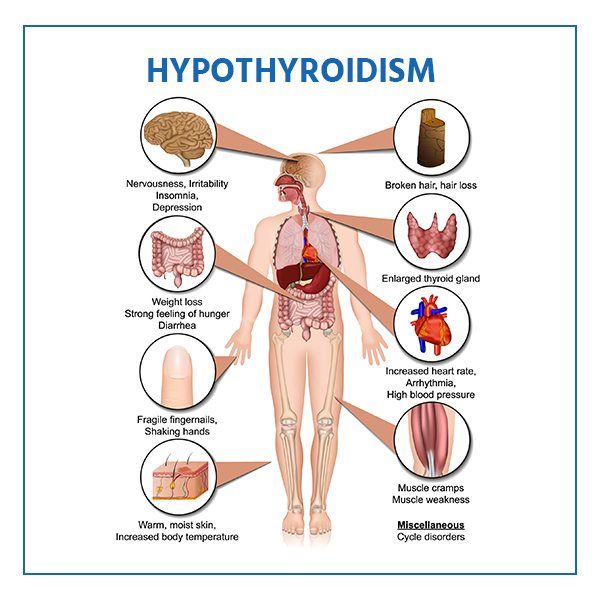
Interestingly hypothyroidism has a very recent history in regard to its treatment. Only in the past 80 years have we synthesized drugs to combat this illness. However, this illness was discovered in times of ancient civilizations and medicines that are homeopathic were used to combat hypothyroidism. The first civilization to encounter hypothyroidism was the ancient Indians and their medical system of Ayurveda. Ayurveda is an ancient system of traditional medicine that originated in India more than 5000 years ago in the Vedic period. It is based on the belief that the mind, body, and spirit are interconnected and that balance between these elements is essential for optimal health. In Ayurveda, the body is believed to be made up of three dosas, or energies, known as vata, pitta, and kapha. Each dosa is associated with specific physical and mental characteristics, and an individual’s dosa type is believed to be determined by their unique combination of these energies. Vata is associated with movement and is thought to be responsible for bodily functions such as circulation, respiration, and elimination. Pitta is associated with transformation and is believed to be responsible for digestion, metabolism, and the production of hormones. Kapha is associated with stability and is thought to be responsible for growth and protection, as well as providing lubrication to the joints and moisturization to the skin. In Ayurveda, imbalances in the dosas are believed to be the root cause of illness and are treated through a combination of lifestyle changes, diet, herbal remedies, and various practices such as yoga and meditation.
In Ayurveda, hypothyroidism is believed to be caused by an imbalance of the vata and kapha doshas, which are two of the three energies that govern the body in Ayurvedic medicine. Treatment for hypothyroidism in Ayurveda typically involves the use of herbs, dietary changes, and lifestyle adjustments to restore balance to the doshas. Some common herbs used in the treatment of hypothyroidism include ashwagandha, brahmi, and shatavari. These herbs are believed to nourish the mind and support healthy thyroid function. In addition to herbal treatment, Ayurveda also emphasizes the importance of a healthy diet in the management of hypothyroidism. Foods that are believed to be helpful for people with hypothyroidism include warm, cooked foods, such as soups and stews, as well as foods that are high in protein and healthy fats. It is also important to avoid foods that are cold, raw, or heavy, as these can further exacerbate imbalances in the doshas. Lifestyle changes, such as regular exercise and stress management, are also important in the treatment of hypothyroidism in Ayurveda. Ayurvedic practitioners may recommend yoga, meditation, or other relaxation techniques to help manage stress and promote overall well-being. Overall, the goal of treatment for hypothyroidism in Ayurveda is to restore balance to the doshas and support healthy thyroid function. By incorporating herbs, dietary changes, and lifestyle adjustments, it is possible to effectively manage hypothyroidism and improve overall health and well-being.
Sources
“70 Years of Levothyroxine.” PDF.js Viewer, https://library.oapen.org/viewer/web/viewer.html?file=%2Fbitstream%2Fhandle%2F20.500.12657%2F47292%2F9783030632779.pdf%3Fsequence&isAllowed=y.
Niazi, Asfandyar Khan, et al. “Thyroidology over the Ages.” Indian Journal of Endocrinology and Metabolism, U.S. National Library of Medicine, July 2011, https://www.ncbi.nlm.nih.gov/pmc/articles/PMC3169859/.
 The Medical Humanist
Leave a comment