
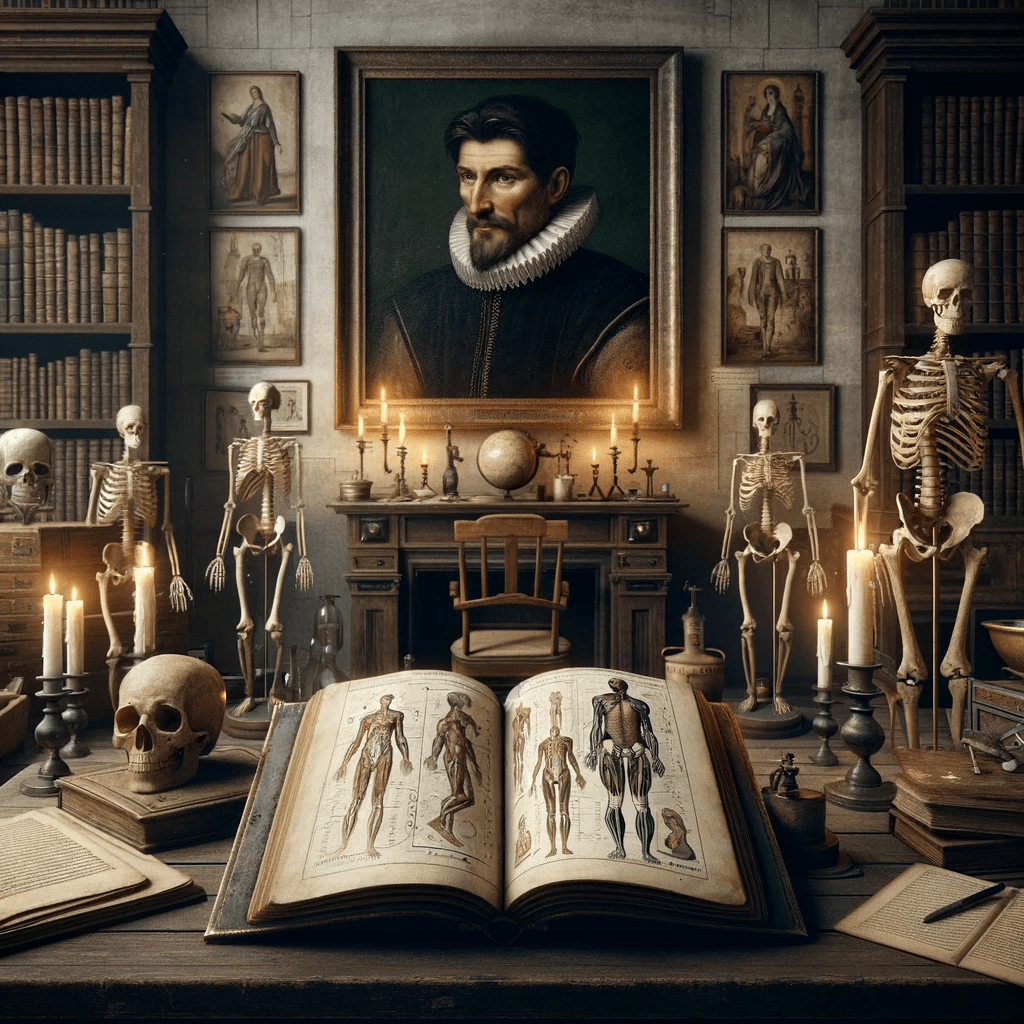
Andreas Vesalius’s life and work represent a pivotal moment in the history of medicine. Born in Brussels in 1514, Vesalius embarked on a journey that would transform our understanding of the human body. His critical eye and dedication to empirical evidence led him to Padua, Italy, where he wrote his magnum opus, “De Humani Corporis Fabrica Libri Septem” (On the Fabric of the Human Body in Seven Books), published in 1543. This monumental work not only challenged existing medical knowledge but also laid a foundation for modern anatomy.
In the first book of “De Humani Corporis Fabrica,” Vesalius takes us into the world of bones and cartilages. Here, he meticulously corrects Galen’s errors, revealing that the sternum has three parts, not seven as previously believed. This book sets the stage by providing a solid framework—the skeleton—upon which the rest of the body’s structures are built.
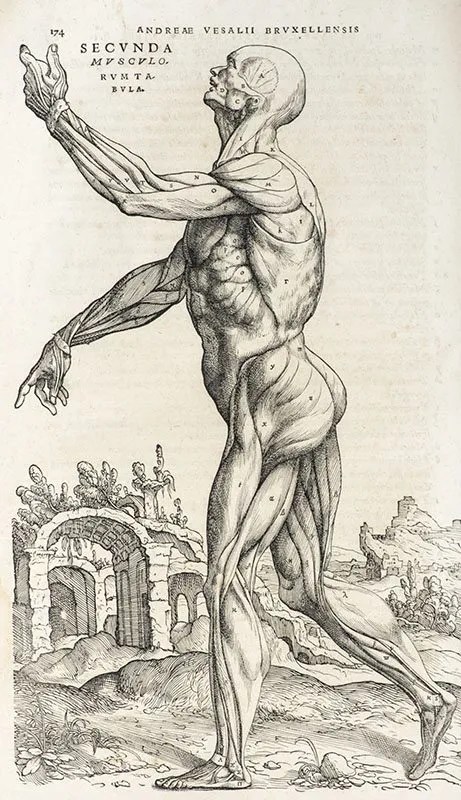
Moving from the rigid structure of bones to the dynamic world of ligaments and muscles in the second book, Vesalius provides an intricate map of the human musculature. He debunks the myth that men have one fewer rib than women, a belief that persisted from biblical interpretations. This book not only provides detailed descriptions but also emphasizes the interconnectivity between muscles and bones, illustrating the body’s complexity.
The third book delves into the veins and arteries, where Vesalius’s dissections reveal the intricate network of the human vascular system. He challenges the prevailing notion that venous and arterial blood have different sources, a crucial step towards understanding the circulatory system. This exploration of blood vessels forms a bridge to the body’s operational systems, highlighting the importance of circulation.
Book four, focusing on the nervous system, marks a significant departure from traditional beliefs. Vesalius illustrates the complexity of the nervous system and its role in sensation and movement. His pioneering work in this area lays the groundwork for future neuroanatomical studies, emphasizing the nervous system’s role in connecting the body’s various functions.
The fifth book explores the organs of nutrition and generation, unveiling the mysteries of the digestive and reproductive systems. Vesalius corrects misconceptions about the liver’s role in blood production and the interconnections of the reproductive organs, highlighting the body’s ability to nourish and reproduce.
In the sixth book, Vesalius turns to the heart and lungs. His observations lay the groundwork for our understanding of the respiratory and cardiovascular systems, challenging the notion of the heart as a seat of the soul and instead portraying it as a complex, functional organ.
The journey culminates in the seventh book, dedicated to the brain. Vesalius provides an unprecedented view of the brain, dispelling the myth of ‘rete mirabile,’ a nonexistent structure believed to be at the base of the brain. This final book symbolizes the pinnacle of Vesalius’s quest, exploring the most complex organ and the seat of human consciousness.
Andreas Vesalius’s “De Humani Corporis Fabrica” is not just a collection of anatomical observations; it’s a journey through the human body, challenging preconceptions and illuminating the interconnectedness of its systems. Vesalius’s work represents a monumental shift from medieval to modern science, emphasizing observation and empirical evidence over tradition and dogma. His legacy continues to inspire and inform the fields of medicine and anatomy.

 The Medical Humanist
Leave a comment