
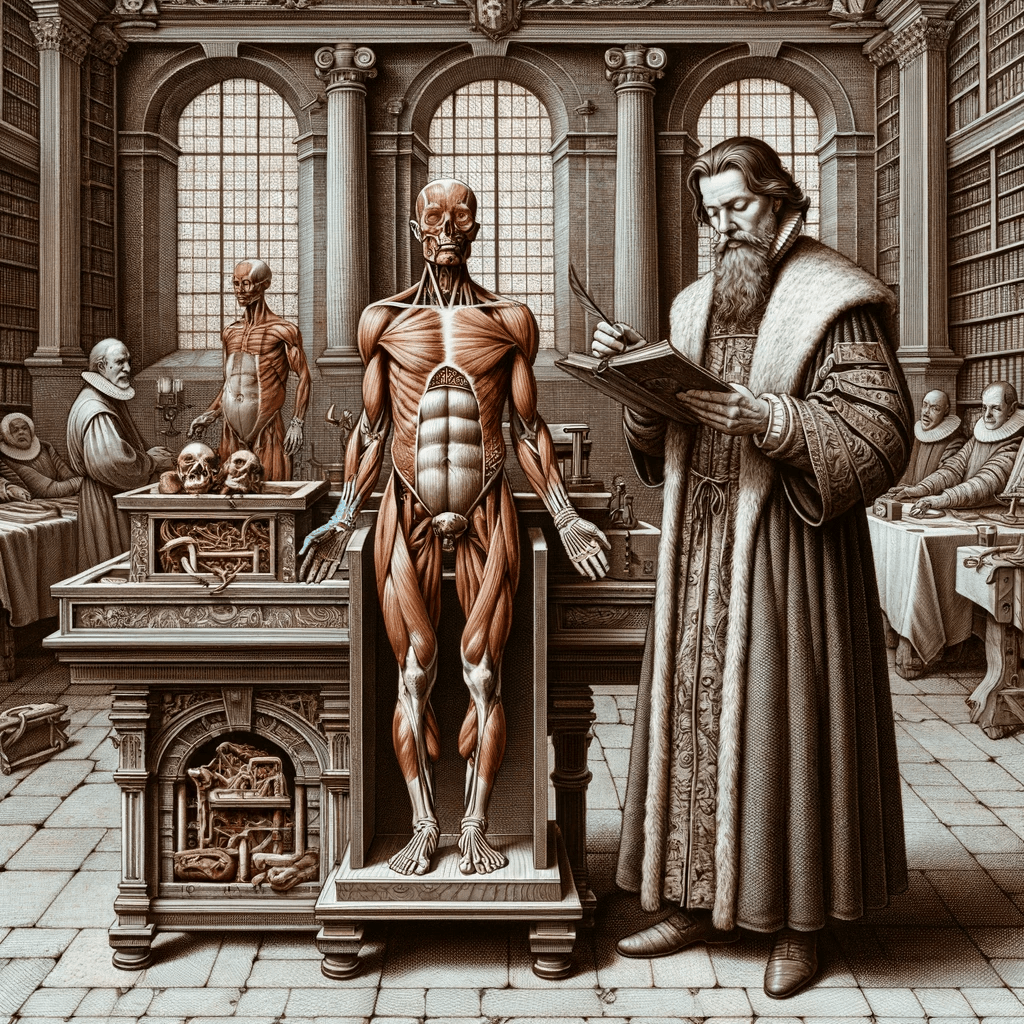
In the rich tapestry known as the Renaissance, a period which redefined the intellectual ideas of science and medicine there was a man named Berengario Da Carpi Giacomo who stands out as a figure of transformative influence. His work and life embodies the time where medical advancements were at a peak.
Born Jacopo Barigazzi around 1460 in Carpi, near Modena, in the then-prosperous Emilia Romagna region, Berengario’s first encounters with medicine were through his father, a reputed barber-surgeon. His formative years in the courts of the Pio family would later converge with the tutelage of the renowned humanist Aldus Manutius, engendering in Berengario a blend of practical medical skill and a profound appreciation for the humanities and Latin, which he would use prolifically in his scholarly work.
Berengario’s journey to anatomical preeminence was not a direct one. After being forced to leave Carpi due to political strife and personal vendettas, he found his way to Bologna, a city in Italy, where his talents as a surgeon and teacher flourished. It was here that he earned his stripes, both through his medical practice and his controversial life, which saw him engaged in violent disputes yet escaping punishment thanks to powerful allies.
Berengario’s fame took a decisive turn with his treatment of the so-called French Disease, syphilis. Employing mercury fumigations and ointments, he garnered attention and wealth, albeit the clinical success of these treatments was limited. Nonetheless, this period marks a pivot in his career, intertwining his fate with that of the Papal Court and leading figures of the time.
Berengarios life has to the potential to make blockbuster movie but for the sake of the medical blog I wanted focus on one piece of work that revolutionized the idea and conceptions of human anatomy. Through a series of dissections, he was able to create an artistic way of depicting the human muscle anatomy. The figure listed below is an example in his book Commentaria super anatomiam mundini.
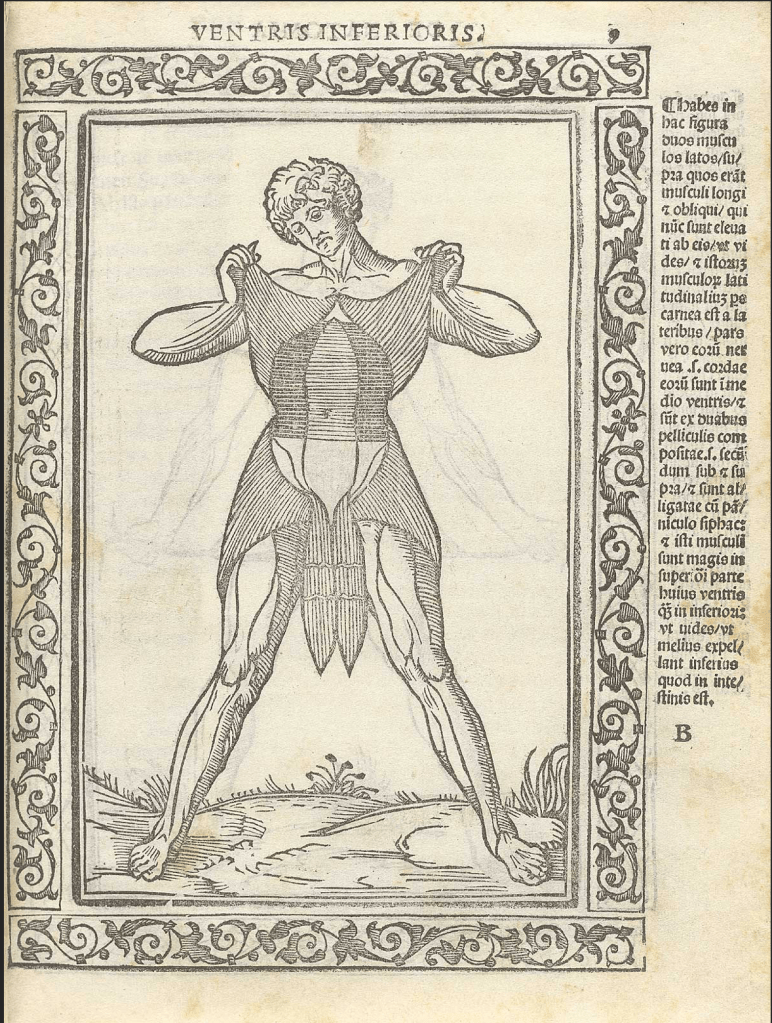
Berengario da Carpi’s “Commentaria super anatomiam Mundini” stands as a seminal work in the history of anatomical science. This comprehensive commentary on Mondino de’ Liuzzi’s “Anathomia” was particularly impactful on the understanding of human muscular anatomy. Berengario’s approach was radical for its insistence on direct observation and dissection over reliance on historical texts. He meticulously corrected and expanded upon Mondino’s work with his own findings, often challenging prevailing inaccuracies that had been perpetuated for centuries.
In “Commentaria,” Berengario provided an unprecedented level of detail regarding the musculature, articulating a more complex and intricate understanding of muscle attachments, structures, and functions. His work included numerous illustrations that were not just artistic representations but precise anatomical diagrams based on dissections, which was a marked departure from the abstract and often inaccurate illustrations of his predecessors.
The impact of Berengario’s work on muscular anatomy was profound. He set a new standard for anatomical accuracy and teaching, contributing to a shift towards a more empirical and exploratory method in the study of human anatomy. His insistence on verification by dissection encouraged others to question and seek visual evidence for medical claims. Thus, “Commentaria” helped to catalyze a movement away from speculative anatomy towards a discipline grounded in observation and evidence, laying the groundwork for the anatomical renaissance that would reach its zenith with the later works of Vesalius.
Berengario Da Carpi Giacomo is a pivotal figure who personifies the Renaissance’s intellectual fervor, especially in the realm of anatomical discovery. His “Commentaria super anatomiam Mundini” reshaped the understanding of human musculature with remarkable precision. By championing the practice of dissection and meticulous observation, Berengario laid the cornerstone for a more empirical and accurate approach to anatomy. His contributions, marked by an unwavering commitment to evidence over tradition, advanced the field of medicine significantly. Berengario’s life and work, steeped in both complexity and brilliance, leave an indelible mark on the history of medicine, elevating him to the stature of an intellectual giant whose influence resonates through the ages.
 The Medical Humanist
Leave a comment