

In the title, I listed part 1 which means, I will be doing a mini blog series on the last four shifts I worked. Over the week, I worked as the standby medical staff at the O’Reilly Auto Parts national convention in Dallas where my team and I had at least 400 patient contacts. One would think that with 400 patients we would have a wide variety of cases, unfortunately that was not the case. Our patients had the common tendency of requesting pain meds for their joints, headaches, and recent surgeries. Many patients also had high blood pressure and wanted to us to give them a checkup. Many diabetic patrons also forgot their glucometers to check their blood sugar and we had to tests for them. Amongst the 400 patients about fifty were true emergencies, which was very significant. Our emergencies consisted of hypertensive signs and symptoms, anginas, and severe anxiety. This blog will focus on our hypertensive patients, the next one will focus on anxiety, and the final and third part will be about a certain patient whose conditions led to an interesting case
The O’Reilly Convention had over 7000 employees attend from assistant managers to executives, these people had visual commonality, overweight and obese. Many people used electric wheelchairs as the convention required too much walking. Most of our patients who had obscenely high blood pressures were overweight and many of them in their 40s. We are used to seeing high blood pressure in much older people beyond the ages of 60, but not here. Our patients who came up to us said they felt fuzzy and “not all there” had the average blood pressure of 200/100 which is extremely high. One patient who we had taken vitals had a Blood Pressure of 220 over 20 and at first, I believed I had made a mistake but, when I tested again on the patient’s other arm, I got the same reading. We attached an ECG machine to him, and it was clear our patient was in atrial fibrillation (a-fib). A-fib is a heart rhythm that is rapid and irregular and it is indicative of heart valve problems that can lead to clots in the organ. When the patient was aware of this he refused to go to the hospital as he believed he would be okay. We informed this patient that he could have a heart attack at any time, especially with all the walking he had been doing and his high blood pressure but, he still refused. This patient was rather obese, and his weight was also putting an extreme strain on his body and heart.
This blog is going to connect to a more recent historical era that still continues on today and that is Americas history on food production and how it has affected millions of lives for the worse. America is known today for its high rates of obesity and foods that are consumed have excess in salt, unhealthy fats, sugars, and refined grains. The question is how did we get here?
The answer to this question can be discussed for many pages but for the sake of this blog, we will talk about my main theory and studies that support it. After the end of World War Two in order to prevent the Great Depression and high unemployment rates again, more jobs had to be created. Especially with the Baby Boom after the war, there was a need for more food and more money amongst families. Major companies today such as McDonalds, Taco Bell, and IN & OUT all rose up after the war and needed to attract customers. Their strategy to attract customers was to create a system were your food will be ready in minutes compared to a restaurant were it takes much more time. This appeal was what everyone wanted as they can easily grab dinner quickly and at a much lower cost. In order to meet these demands, frying and using excessive oils where they key to rapidly produce food. as well as cheaper products that are filled with additives and unnatural substances.

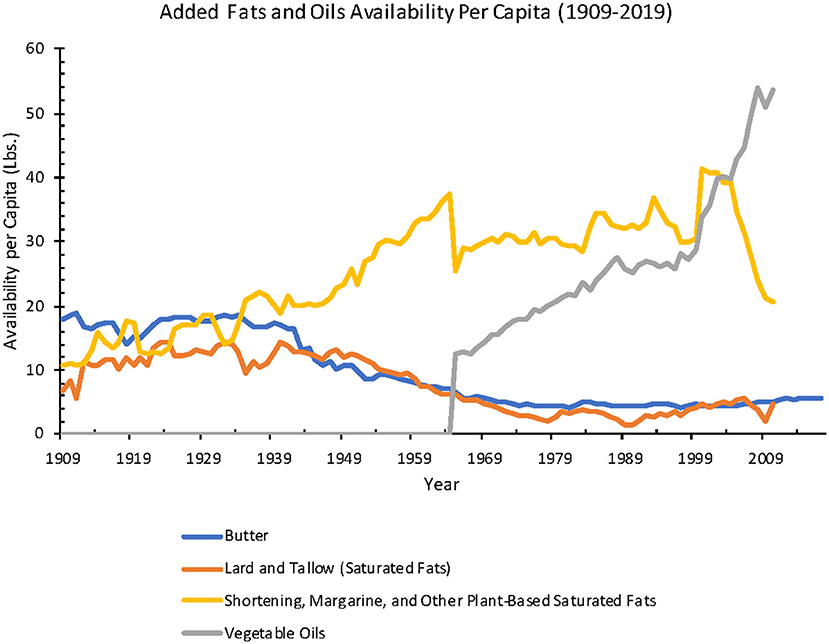
A study done by the frontiers of nutrition tracked the availability of fats in America, and the trend only rises. This is due to the fact there is a rise in fast food chains using fats and oils to cook. Though one may think this is due to the fact that the trend is rising due to rising numbers in population, that is false. In another graph they used it shows the exponential rise of unhealthy vegetable oils that are used by fast food chains and restaurants that are necessarily not considered healthy. This graph also shows a large drop in the viability of healthier oils such as Butter and Tallow.

Sources:
“From the 1940s to Today: How America’s Fast Food Has Changed over the Decades.” The Definitive Website for Food, Recipes and Reviews, https://www.lovefood.com/gallerylist/85389/from-the-1940s-to-today-how-americas-fast-food-has-changed-over-the-decad.
Lee, Joyce H., et al. “United States Dietary Trends since 1800: Lack of Association between Saturated Fatty Acid Consumption and Non-Communicable Diseases.” Frontiers, Frontiers, 20 Dec. 2021, https://www.frontiersin.org/articles/10.3389/fnut.2021.748847/full.
 The Medical Humanist
Leave a comment